
Cervical Stenosis: What It Is, Why It Happens, and What You Can Do Safely
Last updated: January 21, 2026
If you prefer to watch rather than read, this video walks you through cervical stenosis, safe exercises, and common mistakes to avoid
What Is Cervical Stenosis?
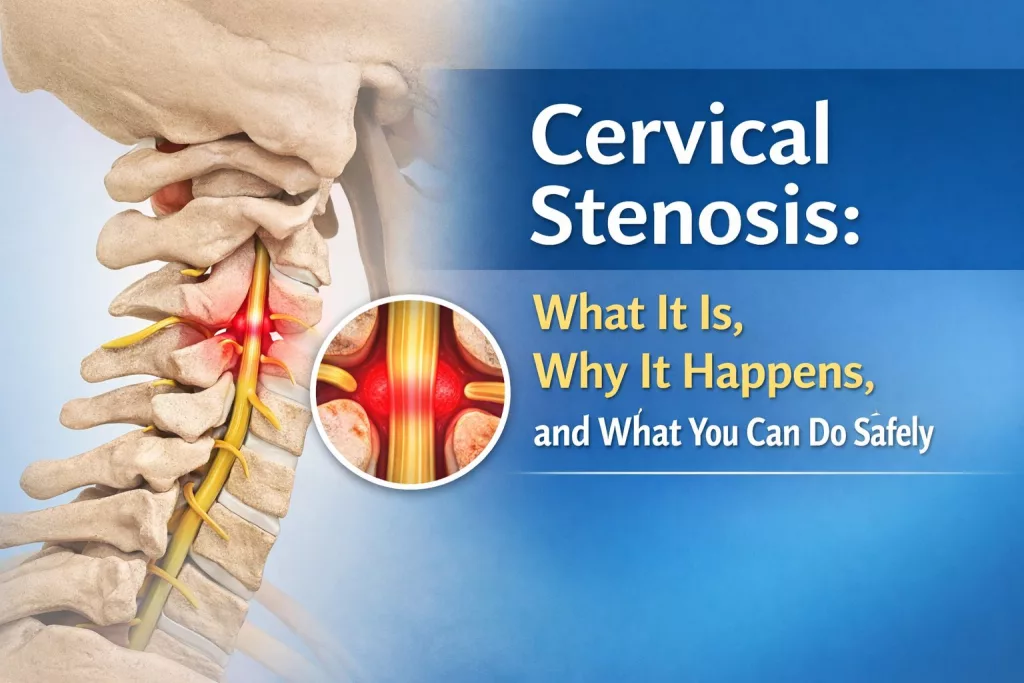
Cervical stenosis—also known as cervical spinal stenosis—refers to a narrowing of the spaces in the neck where the spinal cord and spinal nerves travel. When these spaces become crowded, nearby nerves or the spinal cord itself can become irritated, leading to symptoms such as neck stiffness, arm pain, tingling, numbness, headaches, or a feeling of weakness.
This condition is common, especially in adults over the age of 40. Importantly, many people have cervical stenosis visible on imaging but experience only mild—or sometimes no—symptoms at all. Others may notice symptoms gradually over time.
A diagnosis of cervical stenosis does not automatically mean surgery, injections, or avoiding movement. In many cases, symptoms respond well to conservative care when approached thoughtfully.
Why This Happens
Cervical stenosis almost always develops slowly, not suddenly. It is typically the result of long-term changes in the spine rather than a single event.
Common contributors include:
- Disc degeneration: Discs naturally lose hydration and height with age
- Disc Bulges/Herniation: Injured discs may reduce space and put pressure on nerves
- Arthritis and bone spurs: The body often adds bone for stability, which can reduce nerve space
- Ligament thickening: Spinal ligaments may stiffen and encroach on the canal
- Postural strain: Years of forward head posture increase compressive forces in the neck
- Previous injuries: Old whiplash or sports injuries can accelerate degenerative changes
In practical terms, cervical stenosis is usually a wear-and-adapt issue. The spine responds to stress over time—sometimes in ways that eventually limit space.
A Simple Anatomy Explanation
The cervical spine consists of seven vertebrae stacked one on top of another. Between each vertebra sits a disc that acts as a shock absorber. Through the center of these bones runs the spinal cord, while spinal nerves exit through small openings on each side.
Cervical stenosis occurs when:
- The central spinal canal narrows (affecting the spinal cord), or
- The side openings narrow (affecting nerve roots)
The location and degree of narrowing—and how sensitive the surrounding tissues are—determine symptoms. This is why imaging findings alone do not predict how someone will feel.
What You Can Do at Home
For many people, the goal is not just to try and change spinal structure, but to reduce irritation, improve movement quality, and support the neck over time.
1. Improve Neck Posture Gently
Chronic forward head posture increases pressure on already narrowed spaces.
- Sit or stand tall
- Gently draw the chin straight back (no tilting)
- Hold briefly and relax
- Avoid pushing into pain
Small, frequent corrections throughout the day are more effective than forcing posture.
2. Gentle Cervical Decompression
Light traction can help reduce compressive load.
- Lie on your back
- Support the base of your skull with your hands
- Gently lengthen upward without pulling
- Think “creating space,” not stretching
This should feel calming, not aggressive.
3. Stretch Selectively
Target muscles that commonly contribute to neck strain, such as the upper trapezius or chest muscles.
Avoid forceful neck twisting or deep stretches into pain. With cervical stenosis, controlled motion is safer than aggressive range.
4. Strengthen the Support Muscles
Weak upper-back and shoulder blade muscles increase strain on the neck.
Simple scapular retraction exercises help distribute load more evenly and reduce neck overwork.
5. Improve Mid-Back Mobility
A stiff mid-back often forces the neck to compensate.
Gentle thoracic extension exercises can reduce cervical strain without stressing sensitive neck structures.
Common Mistakes to Avoid
People often worsen symptoms unintentionally by:
- Forcing neck stretches
- Aggressive self-manipulation
- Using hanging traction devices without guidance
- Sitting with poor posture for long periods between exercises
- Chasing quick fixes instead of steady habits
If something causes sharp pain, numbness, or increasing weakness, it’s not the right approach.
How We Help Patients with Cervical Stenosis in Newmarket
At our clinic in Newmarket, Ontario, care for cervical stenosis focuses on reducing irritation, improving movement quality, and supporting long-term spinal health—not forcing motion or treating imaging findings alone.
Assessment Comes First
We assess:
- Neck and upper-back mobility
- Posture and daily movement habits
- Neurological signs such as strength, sensation, and coordination
- Which movements aggravate or relieve symptoms
This helps identify the true drivers of discomfort. We will also review your MRI or CT scan results if you have had any advanced imaging.
Gentle, Appropriate Care
When hands-on care is appropriate, it is:
- Controlled
- Targeted
- Matched to your comfort level
Aggressive techniques are rarely helpful for cervical stenosis. The goal is to improve motion where needed while minimizing stress on sensitive areas. Spinal Decompression may be indicated here as well.
Posture & Movement Guidance
We focus on:
- Practical posture corrections
- Safer ways to move, sit, and work
- Reducing unnecessary compression on the neck
These changes often make a meaningful difference over time.
Guided Home Care
Patients receive guidance on:
- Gentle mobility work
- Supportive strengthening
- Spine-safe daily habits
The emphasis is always on consistency, not intensity.
When Professional Help Makes Sense
Seek assessment if:
- Progressive arm or hand weakness
- Worsening numbness or coordination issues
- Balance difficulties
- Symptoms that do not improve with conservative care
- You want a proactive approach, not a wait-and-see approach
A proper evaluation helps determine whether symptoms are coming from joints, nerves, posture, or a combination—and what approach makes sense.
Book an Assessment
If you’re dealing with neck pain, stiffness, arm symptoms, or have been told you have cervical stenosis and want clear, practical guidance, an assessment can help.
Chiropractic care available in Newmarket, Ontario: Book an in-office assessment to determine what’s contributing to your symptoms and whether conservative care is appropriate for you.
Chiropractic on Eagle
2:30 – 6:00 PMTuesday 7:30 – 10:45 AM
2:30 – 5:30 PMWednesday 2:30 – 6:00 PMThursday 7:30 – 10:45 AM
2:30 – 5:30 PMFriday ClosedSaturday ClosedSunday Closed